|
Data
File Updated:
Friday, June 12, 2026
Taben is the third of the three
Loroi Sister Worlds,
located in the Nonoin system relatively nearby to Deinar and Saramalir
(Perrein). Although Taben has been the junior partner of the
three in many respects, it continues to exert an outsized
influence on Loroi traditions, economy, technology research and
politics. It is home to the headquarters of both the Tenoin and
Listel castes.
The system primary is a G-class yellow star, a little bit
younger than our Sun, with 5 terrestrial planets and a large cometary disk dominating the outer system. The disc is crisscrossed
by icy dwarf planets, but none large enough to carve out a clear
orbit. The most widely accepted theory on the lack of large
planets in the outer system is that Nonoin once had a binary
companion, but which at some point escaped or was ripped away,
taking the outer planets with it. Now the interplay of the dwarf planets
in eccentric orbits is
constantly reshaping the comet disk into ever-changing peaks and
troughs. The inner solar system is frequently visited by comets
stirred up by this activity.

(fig.1: Taben
system diagram.)
Planets III, IV and V are ocean worlds, III and V being super-Earths.
Planet III is
hot and has a hydrogen atmosphere, and planet V is frozen.
Planet V is at about the distance of our asteroid belt (~3 AU).
Aside from the usual
system infrastructure and courier bases, most of the space-borne facilities are located at Taben.
Nonoin IV
Taben is the fourth planet in the system, an ocean-covered world with relatively small land
masses. While
moonless, Taben has an axial tilt similar to Earth's that causes
similar seasonal changes in climate. With no moon to slow its rotation, Taben's day is just 13.6
Earth hours. This fast rotation is part of what drives Taben's
fierce wind and currents, but it also makes it slightly less
expensive to get objects into orbit from the surface. Taben's
orbital period is 1.18 Earth years (431 Earth days).
 The preponderance of surface water and strong currents helps
to distribute heat globally and mitigate the effects of seasonal
change, but there are still major differences in the
climate zones between the cold northern continent (Beleri) and the
warmer equatorial islands (Amenal). The shallowness of the
equatorial
seas also helps to make them much calmer than the deeper, stormy
northern seas. Although seawater freezes at the poles in winter, it doesn't
form a permanent pack and breaks up and mostly disappears in
summer. Without a moon, Taben experiences only solar tides, but
the complex undersea geography and fast rotation can dramatically amplify local
tides and drive ocean intermixing and nutrient upwelling that
benefits marine biodiversity. Taben is still geologically active
and has a strong magnetic field. The preponderance of surface water and strong currents helps
to distribute heat globally and mitigate the effects of seasonal
change, but there are still major differences in the
climate zones between the cold northern continent (Beleri) and the
warmer equatorial islands (Amenal). The shallowness of the
equatorial
seas also helps to make them much calmer than the deeper, stormy
northern seas. Although seawater freezes at the poles in winter, it doesn't
form a permanent pack and breaks up and mostly disappears in
summer. Without a moon, Taben experiences only solar tides, but
the complex undersea geography and fast rotation can dramatically amplify local
tides and drive ocean intermixing and nutrient upwelling that
benefits marine biodiversity. Taben is still geologically active
and has a strong magnetic field.
Taben today still does not have a unified global government, except for the recently appointed Imperial governor.
Beleri is united as a single nation with its capital at the port
of Sezabi, but the island-states of Amenal are still technically
independent nations,
aggregated into a loose economic federation. Taben hosts the
Listel headquarters and important research centers, and its exports
are mainly based on its biotic and mineral wealth, along with
the output of its orbital shipyards. There
are rich mineral veins due to volcanic activity, but the richest
ones are underwater and difficult to exploit. There is some
mining in Beleri and elsewhere underwater (especially the
submarine Pipolsid colonies), but not a lot of
local heavy industry due to the small population and limited
land area. Because of the limited amount of
arable land and the frequency of disastrous weather events, population in
pre-contact Taben never rose much above 50 million, and was
perhaps as small as 30 million at the time of contact.
Beleri and Taben represent two distinct racial groups. Both
are known for large ears and long noses. Beleri Loroi are famous
for dark (often blue) hair, fair skin and yellow eyes. Amenal
Loroi are known for darker skin, curvy figures and green hair.
There had been some intermixing in Amenal islands held by
Belerid raiders prior to reunification, but the isolation
enforced by vast ocean distances kept the two groups mostly
separated.
Anchorage Citadel
The largest of Taben’s many orbital facilities. The
local sector headquarters is located at nearby Deinar, so this
main station has been mostly taken over by Taben's interstellar
shipping companies as a commercial hub. It also includes the
headquarters and orbital annexes of the Tenoin Academy located
in Beleri.
Taben Fleet Yards
A large portion of ship manufacturing for the Minzan Sector
is handled by facilities in Taben, the largest of which is the
Imperial-run Fleet Yards. Taben still has the smallest
population of the three Sister Worlds, and relatively little
local heavy industry, so much of the materials and manpower for
the yards are imported from nearby systems.
Beleri
The northern continent of Beleri is small, but is still the
largest land mass on the planet. It is cold and
mountainous, mostly covered in snow for nearly half the year,
and heavily forested with nagen and native evergreens. Active
geothermal regions provide pockets of ice-free land year round,
and rocky fjords shelter excellent deep-water ports. During
summer, the small northern ice cap melts and the continent turns
green, and residents harvest sibreg fruit and liio seeds from the small river valleys flooded
by meltwater. In the winter, strong tidal currents bring
nutrients that feed algal blooms and large gatherings of marine
animals to be harvested.
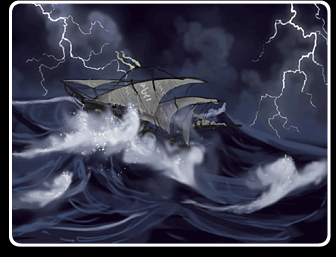 Belerid sailors on the stormy northern seas established a
long tradition of heroic seamanship, from fishing and leviathan
“whaling” to trading and exploring, and even raiding and piracy.
Because of the small population and harsh conditions, Beleri
society did not specialize into warrior and civilian classes,
and the sailors who were de-facto "warriors" engaged in commerce as well as
warfare. Even the Belerid males, famous for being tougher and
less academic than typical Loroi males, took roles in managing
port facilities, businesses and even occasionally traveling
aboard ship themselves. The difficult environment and
adventurous lifestyle mostly kept Beleri population in check
without the need for strict mating controls. It was
usually the practice that young female would be expected to
accomplish some feat (such as adventuring abroad) before being
eligible to mate, but in hard times even this requirement was
sometimes waived. Because of these different traditions
regarding warrior vs. civilian and male vs. female roles, Taben
operates under a slightly different social system to the
mainstream (Deinar) Imperial caste system. (see Loroi Axis
and Taben Culture,
below) Belerid sailors on the stormy northern seas established a
long tradition of heroic seamanship, from fishing and leviathan
“whaling” to trading and exploring, and even raiding and piracy.
Because of the small population and harsh conditions, Beleri
society did not specialize into warrior and civilian classes,
and the sailors who were de-facto "warriors" engaged in commerce as well as
warfare. Even the Belerid males, famous for being tougher and
less academic than typical Loroi males, took roles in managing
port facilities, businesses and even occasionally traveling
aboard ship themselves. The difficult environment and
adventurous lifestyle mostly kept Beleri population in check
without the need for strict mating controls. It was
usually the practice that young female would be expected to
accomplish some feat (such as adventuring abroad) before being
eligible to mate, but in hard times even this requirement was
sometimes waived. Because of these different traditions
regarding warrior vs. civilian and male vs. female roles, Taben
operates under a slightly different social system to the
mainstream (Deinar) Imperial caste system. (see Loroi Axis
and Taben Culture,
below)
Belerid Seamanship
Beleri's distinctive lateen-sail ships were an important part
of their history and continue in use to the modern day, both as
training vessels for Tenoin cadets and as living and working
vessels for the traditionalist groups that uphold the old ways.
The ships are constructed of sturdy nagen wood, waterproofed
with a stain of lacquer of nagen resin, rigged with ropes and
sail canvas woven of liio fibers. They employ an elaborate
rigging system that allows great flexibility in adapting to
changing wind conditions. These ships use mainly lateen sails to
deal with the variability in Taben's winds, and because they’re
more maneuverable in fight-or-flight situations. Merchant ships
for long hauls added some square sails for better long-distance
performance.
Tenoin cadets are often presented with an already-constructed
vessel but which has been razed down to the mast stubs, and
instructed on how to rebuild the elaborate rigging and operate
it. Then they are sent out to sea as part of the wilderness
isolation portion of their training. After the class is done
with the vessel its yards and rigging are stripped down again
(and sometimes ritually burned as part of the graduation
ceremony, as is local custom) to prepare it for the next class.
Tenoin Academy
The Tenoin caste headquarters (with main HQ in Anchorage
Citadel) has some offices in Beleri, and the primary Tenoin
Academy also has facilities in both locations. The traditional
Tenoin training regimen has diral bands training in and around
the port of Sezabi, progressing to advanced studies in the
orbital station.
The Tenoin caste is the largest of the Loroi specialist
classes, focusing on piloting and navigation. Most small craft
pilots are Tenoin, and on larger ships the helm and navigation
staff is usually split somewhat evenly between Tenoin and
Soroin. Tenoin officers may rise as high as executive officer
aboard a large ship, but will usually be expected to transfer to
Soroin training systems to received administrative training
before attaining command rank and being promoted to Torrai.
Overall, the Tenoin, Soroin and Torrai share a more or less combined rank
structure and chain of command aboard a ship.
Taben is strongly associated with the Tenoin caste, as it was
founded after reunification based largely on Taben (Beleri)
traditions (similar to how the Perrein psi tradition became the
Mizol). The relationship between the Tenoin and Soroin in some
ways mirrors that between Taben and Deinar Loroi, and can
somewhat compared to that of the fliers of the US Navy and the
Army Air Corps in the 1930's and 40's: two groups with similar
and sometimes overlapping responsibilities, but who come from
very different backgrounds and traditions. That they are the
most similar in terms of roles undoubted feeds the rivalry
between them, which (mostly) manifests in the form of friendly
competition, since they usually work directly together. Tenoin
pilot specialization was most important when fighters were a
major component of Loroi fleet doctrine, since fighters are too
small to have inertial dampers, and to survive the 40+g
accelerations the piliots must use elaborate fluid-breathing
systems. These are not something you can just jump into without
extensive specialized training, which is exclusive to the Tenoin
caste. In the modern era, small craft have been reduced to a
secondary role, but the Tenoin still maintain their proud
traditions as a separate entity.
 Amenal Amenal
The equatorial archipelago of Amenal sits atop a submerged
continental shelf, and the shallow water provides an ideal home
for vast coralline algal reefs and their attendant marine animal ecosystems.
However, there are no native macroscopic animals, only native
tropical ferns and mosses. Few imported Soia-liron species
survived here: the small chicken/lizard like tirriti,
fruiting sibreg shrubs, and the columnar cactus-like
marret. This meant that despite plentiful food for
fisher/gatherers, there was not much available material to use
for tools or building structures, and large-scale agriculture
was not possible. The result was that Amenal culture remained in
a primitive traditional state even despite some fairly advanced
knowledge. After contact with Beleri and trade for nagen wood,
Amenal developed their own shipbuilding and deeper-water fishing
practices. Amenal science had developed surprisingly effective
medicines from sibreg and marret fluids, which they traded
primarily for wood and other building materials.
The shallow water surrounding the island chain is littered
with the ruins of now-submerged Soia settlements, and even from
an early time the Amenal Loroi had made a cottage industry of
diving for artifacts and bringing them to the surface. Loroi
resistance to pressure and their efficient metabolisms allowed
athletic Amenal divers to descend to remarkable depths for
significant lengths of time, collecting Soia treasure and also
benthic marine animals for food and materials. However, the
paucity of local resources prevented the conversion of much of
what was learned from the artifacts into usable technology, and
so Amenal science remained more academic than technological.
Although Amenal as a region shared a broadly general culture,
each island was its own entity with heterogeneous practices and
rules. The more geographically remote islands became especially
distinct in isolation. As in Beleri, Amenal cultures did not
draw a distinction between warrior and worker, though some
developed elite classes similar to priesthood (without the
religion). Due to limited space, overpopulation was still a
concern, and each tribal subculture developed its own solutions.
Most involved mating being awarded based on a lottery system. A
few restricted mating to an alpha class, somewhat similar to the
Deinar warrior system, and some employed some more exotic and
ritual practices. It is rumored that a few practiced a form of
Loroi sacrifice and even cannibalism, but this is something that
the modern Amenal Loroi tend to deny or discourage research
into.
Not long after the Loroi in Beleri had mastered deep water
sailing, they discovered Amenal and began interactive with the
island tribes. This meant trade but also periodic raiding. There
were a few islands (especial more remote northern ones) that at
various points came under Beleri invasion and control. In some
of these, the occupied societies became somewhat like the Deinar
warrior/civilian model, with the Beleri conquerors as the
warrior class and the conquered Amenal as the civilians. But
most of the time, these hybrid societies only remained distinct
until the ruling Beleri were absorbed into the more hedonistic
Amenal culture. Aside from these regular raid and the more rare
Belerid occupations, warfare was relatively rare among the
islands. The available resources didn't support it.
Males in Amenal had similar protected supporting roles as
those on Deinar or Perrein. In some subcultures they were
directly involved in the pseudo-fertility rites that surrounded
the mating lotteries.
Listel Headquarters
The Listel headquarters is located on the “big island” of
Soladra in Amenal, as is one of the major Listel academies.
Numerous research organization study the submerged Soia ruins
and the vast marine ecosystem. Together with the nearby Pipolsid
colonies, Soladra has become one of the foremost centers of
science and learning in the empire.
There was evidently a major Soia-era colony in what is now the
submerged continental shelf, as Soia artifacts litter the ocean
floor, and the impact craters from the orbital bombardment that
ended the Soia era are still quite visible.
Pipolsid Colonies
There are numerous submarine Pipolsid colonies in the shallow water of
the continental shelf near the Amenal islands. The Pipolsid
science academies contribute significantly to the Taben research
economy, and they are well suited to access both the ancient
ruins scattered across the submerged continental shelf and
Taben's undersea mineral resources. There are nearly as many Pipolsid living on Taben as
there are Loroi.
Flora and Fauna
Taben’s native life is in a stage roughly analogous to Earth’s
Silurian period: life thrives in the oceans but is still too
primitive to fully colonize the land. Land plants are limited to
moss-like and fern-like forms, and only tiny arthropod-like,
worm-like and slug-like animals can be found on land, with life
cycles still closely tied to the water. Although there are no
macroscopic native land herbivores or predators, there are tiny
and microscopic scavengers and decomposers that will consume
dead plant or animal matter (unlike on Deinar, where a dead
animal could lie undisturbed except for wind and weather for
years).
The native plants flourish in the tropical Amenal islands, but
struggle more in cold rocky Beleri. A few cold-resistant species
of fern-like and moss-like plants have carved out small niches
in sheltered spots in the southern portion of the continent,
especially those with local geothermal activity. Of particular
interest to the native Loroi are the plants that store sugars
and alcohol to help withstand the cold. The alcohol has no
intoxicating effect on Loroi, but it has caloric value and
medicinal and preservative applications.
Marine organisms are primitive but abundant. Marine plants are
similar to algae, but include colonial forms like seaweed and
coralline algae. There is a variety of zooplankton and primitive
animal forms similar to Earth's marine arthropods, molluscs and
worms. The most sophisticated native animal life is the
sallostii jawless fish, described below. Global and local
currents and tidal actions create regular and periodic
upwellings of nutrients from the ocean depths, which trigger
algal blooms and attendant feeding frenzies of marine animals.
Soia-liron Organisms
The usual Soia-liron domestic organisms had accompanies the Soia-era
colonists, but only a few survived the collapse of the colonies.
Soia-liron livestock and crops are mostly specialized for either
actively tended farms or for marginal terrain, especially
temperate and arid plains. Left to the wild, most were not able
to survive in the harsh cold of Beleri or the wet and sandy
tropical soil of Amenal.
Sibreg was the one Soia plant to persist in both environments,
with adaptations to both cold and arid environments and
tolerance of poor soils. The conifer-like nagen trees thrived in
some Beleri regions but could not establish a hold in Amenal.
The cactus-like marret grew fairly well in Amenal, useful for
their accumulated water and sugars, and for their cholla-like
woody skeletons, which were the most significant available
building materials in Amenal prior to the importation of Beleri
nagen wood.
The grasslike misesa and liio survived but in small areas,
unable to dominate as on Deinar without open plains. Liio is the
more common grain in Beleri with its better tolerance to cold
and wet conditions,
used to make flatbread from its oily seeds and canvas and rope
from its tough plant fibers. Misesa growth is limited to a few
river valleys.
Piglike miros suvived in small numbers in Beleri, but had become
completely feral by the time of the arrival of the Loroi
refugees. Miros did not survive on Amenal. There are tirriti on
Amenal, but not Beleri -- they could not survive in the wild
with the lack of food in winter and the cold temperatures (tirriti
can grow insulating filaments in response to cold climates, but
even this was not enough),
Sallostii (Jawless Fish)
This is a general class of jawless cartilaginous marine animals,
ranging from the tiny, extremely primitive lancelet-lie
litipodi to the giant filter-feeding leviathan and the
relatively sophisticated, energetic wave-hopping nimai.
Sallostii have characteristics similar to Earth agnatha
(lampreys and hagfish): they are ectothermic, without skeletons
or jaws and with a modest metabolism. Most have a long gut with
no distinct stomach, and simple circulatory systems lacking
distinct hearts. They have a spinal cord but most have no
distinct brain. Those that are not completely blind have only a
single pineal eye (with a few exceptions, including the nimai
and relatives). Most are snakelike or eel-like without paired
appendages, though some of the more derived species have
manta-like lateral extensions of the body to aid in propulsion.
Most have a larval stage that resembles the litipodi. Most have
rows of many pharyngeal slits, used mainly for filter feeding in
more primitive or juvenile forms, and developed into gills for
larger and more active derived species. In addition to the three
groups detailed below, other sallostii groups include:
- Small to medium-sized benthic feeders that process
seafloor sediments for detritus and microbial mats
- Small free-swimming mid-water plankton feeders
- Medium-sized armored shovel-headed bottom feeders
- Larger free-swimming form that hunt smaller swimmers or
are parasitic the larger filter feeders
- Large filter-feeding swimmers
The most abundant and diverse forms are found in the shallow
water coralline algae reefs, where the more stable environment
provides more reliable food sources and better protection from
the elements and predators
Litipodi (Wrigglers)
These are very primitive, mostly tiny benthic filter feeders,
similar to lancelets. They are mostly blind and with only the
most rudimentary nervous and muscular systems. They breathe via
diffusion through the skin, using their gill-like slits only for
filter feeding.
Litipodi feed by burying themselves in sediment with only their
front sticking out to siphon seawater detritus and plankton.
Many of the derived sallosti species have a larval form that is
nearly identical to the litipodi, and so the true adult litipodi
usually compete alongside the larvae of the other forms.
Litipodi are so common, abundant and simple that they are often
kept in fishbowls by Loroi school children, who may use them for
study, as display or pets, or as impromptu snacks.
Darraner (Leviathan)
These are free-swimming filter feeders that are directly
descended from the litipodi, but can grow to sizes surpassing 20
meters. Leviathan have a large trapezoidal main body, extended
to each side into pseudo-winglets, and trailing in a large
powerful tail with vertical flukes. A large wide mouth admits
seawater, strained through rows of baleen-like plates in the
pharynx, and expelled through long rows of huge gills. Leviathan
have only a single pineal eye on the top of the "head", and only
the most rudimentary distinct brain. They move slowly and
efficiently, without no natural predators or need to chase prey.
They seasonally migrate to follow algal blooms, but otherwise
seem to wander randomly.
Leviathan lay large amounts of tiny eggs that spawn tiny larvae
that are very similar in form and lifestyle to litipodi. These
larvae feed and grow until they are 10-20 long and have
accumulated sufficient energy reserves to undergo metamorphosis.
At that point they burrow into the sediment and spend several
weeks to several months transforming into the free-swimming
adult form. If they survive long enough to grow to full size,
the adults become essentially immune to predation, though they
are still plagued by lamprey-like parasites.
Leviathan were regularly hunted by the Taben Loroi, especially
in Beleri. Especially prized were the baleen-like filter plates,
from which are made the traditional nilnol folding knife.
 Nimai (Banshee) Nimai (Banshee)
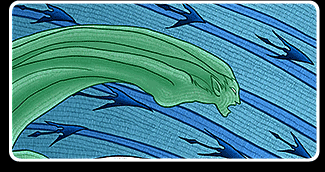
Probably the most sophisticated native animal on Taben, the
nimai is a medium-sized active predator of the open ocean and
reefs. It has an arrowhead shaped body with which it "flies"
through the water like a ray, and the tail has thinned and ends
in a flared flattened diamond. It has two more developed eyes in
addition to the dorsal pineal eye. They ingest prey through
suction, and rasp at they with many rows of conodont-like teeth,
driven by a complex tongue,
Nimai are energetic enough that they can breach the surface and
appear to glide for short distances, making a shrieking sound of
air through their gill-slits as they do so. The Loroi are unsure
of what purpose this breaching serves, whether for mating or
some kind of territorial display -- there are few larger
predators that could drive it as an escape mechanism. Loroi have
traditionally associated with the "furies" of the heroic myths:
harbingers of storms and misfortune, and symbols of vengeance.
History of the Colony
- There was some kind of Soia-era settlement in Amenal
going back to the mid-Soia period. There is no direct
evidence of who manned this settlement, though it is
surmised from recovered artifacts that it was some kind of
marine research colony.
- The first direct evidence of Loroi on Taben appears
coincident with that on the other two Sister Worlds, at the
time of the Soia Fall.
- Loroi survivors established bases on Amenal. These did
not suffer the same boom and bust cycles as those on early
Deinar, due to the lack of ample food supplies (misesa not
growing well in the tropical climate). However, the storm
season can be very harsh, and most of the early settlements
were eventually destroyed by inadequate preparation for the
typhoons.
- Loroi also settled Beleri at the same time, but if they
set up technological outposts, they failed immediately, as
there is no trace of them. The survivors quickly regressed
to a primitive fishing lifestyle, in sheltered southern
coves.
- Life on Beleri is harsh enough that they don't need
population controls, and there is no cultural split between
worker and warrior. Amenal has limited food but a fairly
stable environment, so population must be controlled but
they use a different system -- perhaps a lottery. They also
don't have a warrior class at all.
- beleri ships frequently raided the Amenal islands once
they were discovered.
- Amenal has little wood, and so limited shipbuilding
capability.
- Both Amenal and Beleri were still in pre-industrial
societies at the time of contact by Deinar starships.
Contact and Reunification
Farseers on Deinar detected the existence of the Loroi colony on
Taben only 12 years after having finally visited the Perrein
colony, but Nonoin was significantly farther away. Contact had
to wait Menalo refueling depot outpost to reach Taben, which
took an additional 52 years.
While by the time of the contact
in 895 CE the Amenal had sophisticated academic institutions and
substantial knowledge of science, they still lived in tribal
enclaves, and Beleri Loroi
still sailed wooden ships. Fortunately, the Amenal scholars were
well positioned to absorb the new information and tools from
their new Deinar benefactors, while the more traditional Beleri
Loroi lagged behind, inverting the traditional power dynamic
between them.
Taben joined with Perrein and Deinar to form the Axis Assembly,
a loose confederation of their many individual nations banded
together to deal with the looming threat of nearby alien
civilizations which Farseers had detected but which had not yet
been contacted. This threat would eventually materialize in the
form of war with the Delrias. The Assembly had little authority
over its sovereign members but had initially received sufficient
support to deal with the Delrias threat, but the shortcomings of
this system would begin to manifest as the Loroi sphere of
influence grew and encountered more dangerous opponents.
The Splinter Wars
In 1323 CE, 428 years after contact with Deinar and Perrein, and
28 years after the end of the Delrias war, the "Splinter Wars"
were a series of conflicts primarily between Taben's and
Deinar's interests over the latter's encroaching cultural and
political dominance, although there were entities and
individuals from all three sister worlds on both sides. The
conflict began as a political fight in the Axis
Assembly, and it probably boiled down to a clash of
personalities between Loremark and some Taben personage.
Eventually the conflict went hot and Loremark won, and
established the Imperial system based on Deinar under her as
First Loroi Emperor. The Axis
Assembly was phased out over time, and eventually Loremark
instituted reforms to unify Loroi institutions, merging the
castes into more or less their modern forms, and abolishing the
clan system.
The Loroi Axis
Although the Amenal Loroi integrated better in general than
those in Beleri into the new pan-Loroi culture, both groups
struggled at time with their very different social systems and
their traditions of self-rule under the growing Imperial system
established by Loremark. The Beleri traders in particular had
difficulty integrating what the Deinar Loroi considered to be
civilian practices into the general warrior class system. While
the Taben merchants had earned some exemptions under the new
system, there were features of the anti-corruption bans on
certain kinds of commerce on which Loremark's administration
would not compromise, and which some of them found intolerable,
forcing them to re-designate themselves as civilians. The result
was a mostly civilian group that still retained some rights of
the warrior class (including reproduction), with an axe to grind
with the Imperial system, and significant resources with which
to press their agenda. These merchants and their allied
interests formed a loyal opposition party, naming themselves the
Loroi Axis, in reference to the now-dissolved international
council. Although the Axis included members from across Loroi
territory, its character was distinctly of Taben, and of Beleri
in particular. Despite being viewed by many Loroi as
technologically and culturally backward and few in number, the
Beleri Loroi continued to cast a large shadow.
The Neridi Succession War
After Loremark's death to old age, in 1632 CE, her successor
Second Emperor Swiftsure was more open to the complaints of the
anti-Imperialists. She decentralized some Imperial functions and
revived the Axis Assembly. Unfortunately this shift led to the
rise of the power of the sector governors at the expense of
central authority. Friction grew between Swiftsure and Eighth
Dawn, governor of the Seren sector, until they backed different
claimants in a Neridi succession dispute and the friction flared
into open conflict between the Imperial and provincial forces.
The Taben-affiliated Axis party backed the Imperial faction
(which ironically they saw as more friendly to anti-Imperial
republican interests), which was unfortunate for Taben, since
the provincial forces were quickly and decisively victorious.
The result was a return of centralized authority under Eighth
Dawn as Third Emperor, the second dissolution of the Axis
Assembly, and increasing restrictions on the Taben
warrior-merchants and their interests.
The Bluecrest Rebellion
Although the Loroi Axis were vocal about their displeasure with
the situation, Eighth Dawn's new administration was so effective
that it ushered in an unprecedented age of expansion and
prosperity for the Loroi, and even the staunchest republicans
had to grudgingly admit that her system was working well (as it
made them quite wealthy). Until the Loroi suddenly found
themselves under attack by the Umiak in 2139. Loroi industry
struggled to make up for the losses incurred during the early
Loroi setbacks, and fingers started to be pointed at civilian
industrialists (including the Taben traders) who had been slow
to shift to war production and continued to prioritize profit,
even as the tide of war continued to shift against the Loroi.
Eighth Dawn was reluctant to antagonize the private sector (and
Taben specifically) in wartime, despite warning calls from the
Mizol community. Admiral Greywind in particular was as vocal on
the subject as the Loroi Axis had been against Loremark, quickly
earning her the enmity of the commercial interests. When Eighth
Dawn was killed in action in 2140, and Greywind appointed Fourth
Emperor, a cabal of conspirators including Loroi Axis stalwarts,
civilian plutocrats and Taben shipping magnates enacted a plan
to depose Greywind almost immediately after she had been named
emperor. Unfortunately for the conspirators, Greywind's Mizol
allies were aware of the plan from its inception, and its
leadership was quickly beheaded. While there was still mopping
up of followers to be done, the coup attempt had failed even
before it had been fully put into action.
The fallout for the associated business interests, including
those on Taben, was severe. Many private industries related to
war production were nationalized, and without compensation for
those that had been associated with the conspirators. Some
private property was seized. Many of the special privileges that
had been afforded the semi-warrior-semi-civilian Taben traders
were revoked, and Taben was placed under an Imperial governor
for the first time in its history. Nearly all high ranking Loroi
with any affiliation with Loroi Axis (including Stillstorm) were
relieved of command and suspended from duty pending
investigation. Many were tried and convicted of war profiteering
and/or outright insurrection, and executed.
Taben Culture
Although the Taben Loroi and their descendants throughout the
empire have always been a small minority in terms of population,
their culture and political philosophies have had an outsized
impact on Loroi culture at large. The manifestos of the Loroi
Axis continue to be at the core of those with republican
leanings across Loroi space, and their philosophies of fate and
fortune are mainstream in many places outside Taben.
Part of this is because of the influence of Taben-based
interstellar traded and shipping companies, the early supremacy
of Taben-based military shipbuilding, and the traditions of the
Taben-oriented Tenoin caste.
Social Systems and Economy
Both Beleri and Amenal social systems operated very differently
from those on Deinar or Perrein, they have different rules to
most of the rest of the empire. In some ways the Belerid and
Amenal cultures operated as de-facto warrior and civilian
cultures, respectively.
Taben warriors had some special extra allowances for personal
wealth (direct ownership of some assets that might be required
to be in a family trust or government controlled fund in other
worlds). Some Taben civilians who were among the warriors who
resigned in protest over the new agreement were allowed to keep
some warrior privileges, including reproduction and
participation in government.
Amenal perhaps has a somewhat unique culture for a Loroi nation
even today, not being focused on the warrior class or martial
values. The islands have a fairly small population and their
primary modern relevance is the scientific academies located
here (initially due to the submerged Soia ruins), including
Pipolsid colonies, and the islands may be a vacation spot.
Amenal might be a case of a local Loroi nation that is not run
by warriors and which eschews the division between warriors and
civilians, and this will mean that a lot of what they do loses
legal credibility when one leaves Amenal territory.
There are a variety of rules concerning eligibility for these
special rules. For example, the special warrior-trader status is
only available to native Taben Loroi of the proper lineage -- a
Loroi civilian from another world cannot simply emigrate to
Taben and claim these privileges.
Many of these special privileges were suspended or revoked
after the Bluecrest rebellion, when a lot of warrior-trader
property was seized and some of their businesses privatized.
A few Deinar guilds set up shop in Beleri to help modernize
the locals after contact, as they were in a fairly primitive
state, but the Taben Loroi were and are fiercely independent,
and they also had their own commercial system that was run by
what was essentially the warrior class. Taben refused to grant the guilds the status as monopolies that
they were accustomed to, so their expansion on Taben was limited. Taben
doesn't have much industrial capacity, with a small population
and land area. The main
exports from the North are marine goods, harvested and exported
by a few guilds, a bunch of diverse local companies, and a
community of independent ship operators.
 Dalid
and the Diral Seii Dalid
and the Diral Seii
Beleri Loroi developed a somewhat bleak nihilistic philosophy as
a coping mechanism for their extremely dangerous lifestyle. In
the similarly bleak environment of the current war, this
philosophy has found appeal with Loroi born since the start of
the war who have never known any other way of life.
Dalid is a concept of luck, which isn't unique to Taben
but finds its most popularly recognized form in Beleri culture
and the tradition of the Tenoin diral seii.
The concept of dalid is part fortune and part fate, and it
concerns itself with subjects like victory vs. defeat and
survival vs. death, rather than things like lucky dice rolls or
scoring well on an exam. Simply put, the concept of dalid is
that fortune is to some extent a zero-sum affair: for someone to
experience good fortune, someone else has to experience bad
fortune. It's also tied into their expectations of duty and
leadership. An individual who endures hardship is thought to
ease the hardship of those around her, and an individual who
survives at the expense of others is not someone that others
want to be around. Heroism means sacrifice and the burden of
misfortune. While Loroi idolize their heroes and elevate them to
legendary status, they are saddened but not surprised when they
are the first ones killed.
The ritual manifestation of this concept is the Tenoin diral
graduation ceremony. The seii is a ritual totem, that is representative of the
fortunes of the diral band (a group of Loroi warrior youths in
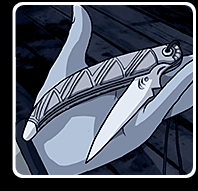
training). It is usually a tool or knife of some kind (such as
the folding nilnol, pictured), but it
can be anything that was made by one of the band members (so
long as that class of object is allowed in the band), and it is
inscribed with the band’s representative glyph during the band
naming ceremony. The band leader carries the seii as a badge of
office, usually in a visible location, and is responsible for
keeping it safe. Since it is usually a tool and will often need
to be used as such, this can be a difficult job. For the seii to
be broken or lost is considered to be a significant misfortune
to the band.
Upon graduation from the trials, when the rigging from the
band's ship and their other training tools are ritually burned
as a rite of maturation, the seii is taken from the
leader by an elder and thrown into the fire, symbolizing the
dissolution of the diral band. By tradition, one of the band
(usually the leader) retrieves the seii from the fire before it
is consumed, usually with accompanying injury. She then keeps it as a
totem for the good fortune of the future of the ex-band members.
If she dies, as it is assumed that she inevitably will, the seii
is passed to the next in line of the former diral members, who
then takes the burden of misfortune upon herself, and so on down
the line until there are no living members left.
Holidays
Truce: Taben does have seasons, so there is
probably a yearly algal bloom that triggers a feeding frenzy
that the natives take advantage of, harvesting seafood. There’s
a kind of thanksgiving feast afterward in the tradition of Beleri and Amenal sailors observing a truce to take advantage of
the bounty. They hold a regatta and feast.
 The
Legend of Tempest The
Legend of Tempest
Although it is generally agreed that the legends of Tempest
originated before the Soia Fall (similar legends exist in the
mythology of all three isolated Sister Worlds), Tempest is most
strongly associated with Taben because of the many references to
the sea. Many of the places and creatures referenced in the tale
have become associated with Taben locales and native organisms.
During pre-reunion Taben history, the legends were probably
assumed to be part of Taben history, since much of the physical
evidence of Soia civilization had been erased, especially in
Beleri.
Tempest was a warrior of the ruling clan in a coastal
city-state. Her wicked sisters, jealous of her influence,
conspired to have her assassinated. While on a naval sortie,
Tempest was thrown overboard and
left to drown. Tempest survived and allied herself with the
local sea-spirits (nimai and bedein and tírrir), performing
deeds for them, such as the recovery of the Eye of Storms, a
bauble that gave the wielder control over the weather. Then she
marshaled an army of sea-spirits and returned to her city to
kill pretty much everyone. Some version of the story go on to say that the dead
were then forced to serve her.
See also:
Loroi,
Loroi
Timeline,
Loroi
Sister Worlds
|





